NATO, politics, and the fights it still isn’t ready for
At its largest military exercise of the year, NATO showed speed, scale and coordination. But watching from the frigid North Sea beach, the absences were harder to ignore.
As NATO foreign ministers meet in Sweden this week, the world’s most significant military alliance is facing some of the biggest challenges in its history. Thousands US troops are withdrawing from Germany and possibly Poland. Contributions to defence budgets and NATO itself are growing but still under the spotlight, and the combat readiness of Western militaries is being questioned, thanks to the conflict with Iran and the war in Ukraine - still going four years after Russia’s full-scale invasion. Its borders and responses are being tested too. Latvia on Thursday activated NATO fighter jets after another drone was detected in the country’s airspace - at least the second time that’s happened in the Baltic countries this week. Ukraine has apologised for incursions of its drones into countries including Latvia - but it is another reminder that conflict is not remote for NATO. Questions about the alliance’s future and its capabilities endure despite claims from members and NATO leadership that it is prepared for combat and modern warfare. Yet I and others have seen firsthand why those questions endure, standing on a frigid German beach in February.
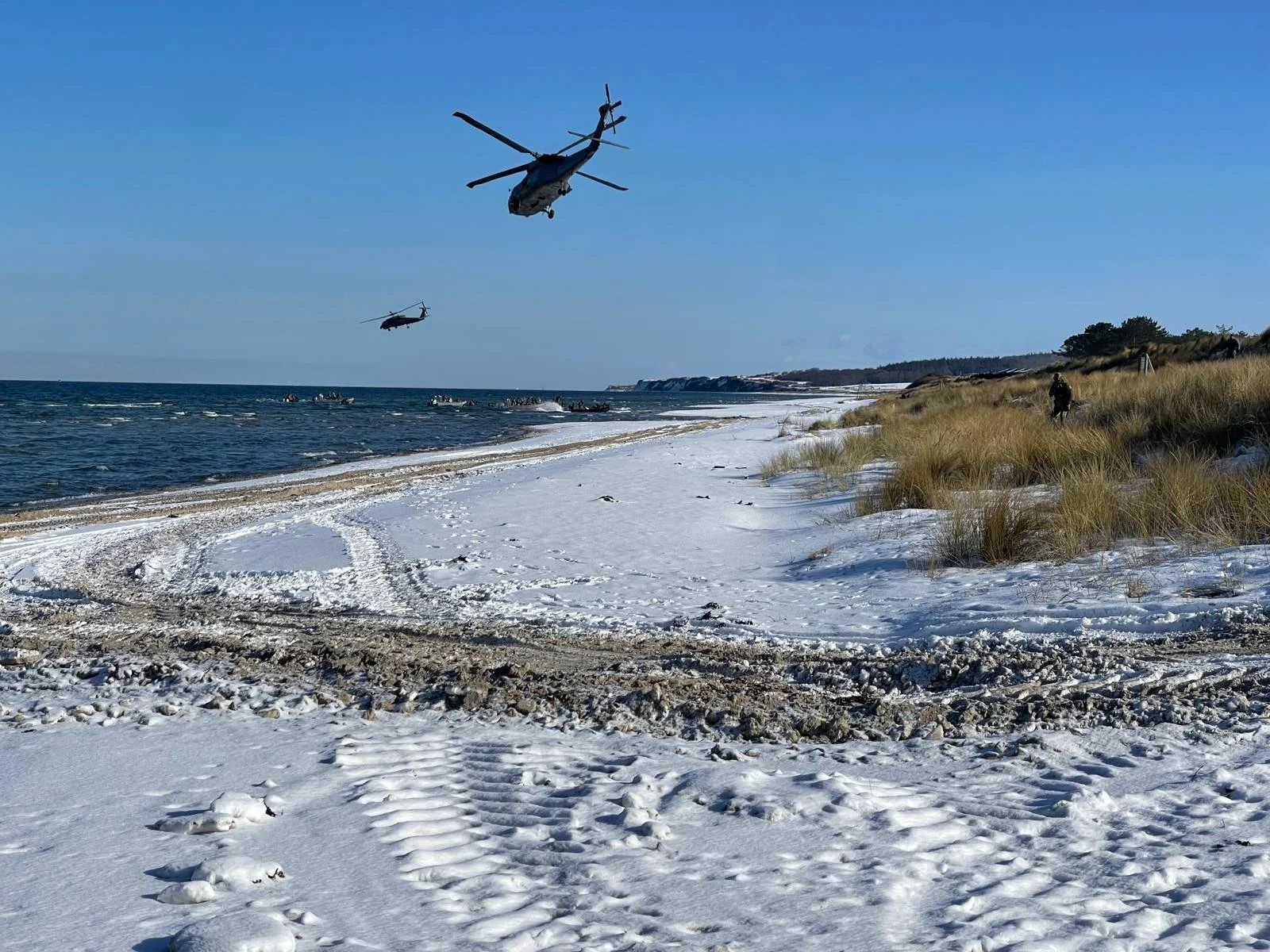
Helicopters and soldiers taking part in a beach landing during Steadfast Dart 2026 on Germany’s Baltic coast.
We were told the Eurofighters would fly low over our heads on the beach of Germany’s Baltic coast at 1020 that morning. When it reached 1045, we were still listening out for them.
They eventually arrived, screaming past and making way almost immediately for Turkish attack helicopters. Sea Hawks then inched themselves into a hover above the dunes a few metres away, loosing ropes for the maybe two dozen soldiers on board to shimmy down and “secure” the beach. Zaha amphibious craft landed and loudly barged their way through the sand just a few metres in front of us.
Steadfast Dart was NATO’s largest military exercise of the year, focussing partly on its Allied Reaction Force - the first responder of the alliance. The amphibious landing we were there to watch on February 18 was over in the space of about 25 minutes.
Germany’s defence minister and the military commanders of the German, Turkish and Spanish contingents leading the operation, spoke proudly of the operation’s success. Yet both privately and on the record, they chose not to confront the elephants on the beach with them.
For all the spectacle we’d seen, there were three absences from NATO’s mocked-up “battlefield.”
The most notable of them of course was an enemy.
Rapid deployment and interoperability was - we were told - the focus of this exercise, and to that end it was impressive. Yet as with all such demonstrations, it was fictional to imagine deploying like this - in this manner - with no opponent.
There was no simulation of enemy attacks, no supposed electronic warfare, let alone the drone coverage that is well known to plague the battlefields of Donbas and likely any future conflict NATO could conceivably need to fight.
This was the same the following day, as NATO sat the media in a grandstand (readied with blankets and binoculars for VIPs arriving the day after us). We were shown yet more helicopters and attack vehicles coordinating - this time with the support of artillery. Spanish special forces were supposed to show up, but didn’t. A rumour going around the stands was that -10C was too cold.
I texted friends on the frontlines in Ukraine about this, who observed that they had spent most of the winter with limited power and temperatures regularly -20C and lower.
The question of drones hung in the air too - far longer than NATO’s airborne equipment during the demonstration. An attempt to demonstrate a new Shahed (the Russian and Iranian suicide UAVs) counter-drone hunter was cancelled, owing to technical issues. The Turkish Bayraktar TB3 was the only other drone technology taking part in the exercises - providing a landscape overview for the first time in an amphibious assault.
There were no other drones - no tiny propellers buzzing in their dozens, no fibre optic cables littering the battlefield, no loitering munitions with small cameras operated by an enemy.
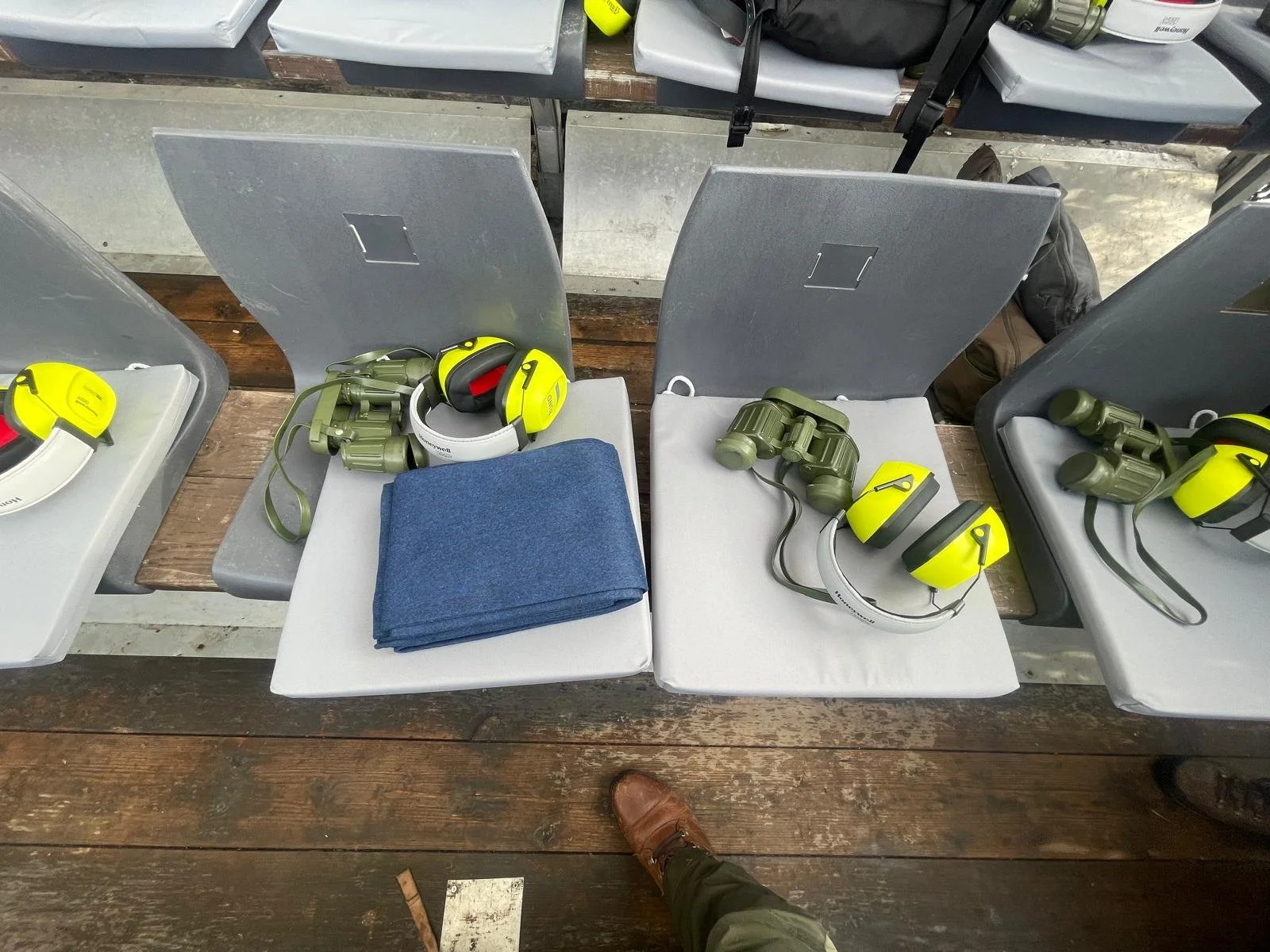
Blankets, binoculars and ear defenders laid out for observers - a reminder of how carefully staged NATO’s public demonstrations can be.
A significant absence too was the United States. No visible indication of American presence nor involvement in the exercises. Donald Trump has moved to withdraw US troops from Europe in their thousands, and NATO’s Supreme Allied Commander in Europe, General Alexus Grynkewich, said the continent should “absolutely” expect more redeployments and structural shifts in the future. He’s called it an “ongoing process” that could last several years. Yet Germany’s defence minister Boris Pistorius bristled when this came up. He talked about the “logistical complexity” involved in the large coordinated deployment - which was supposed to demonstrate the swift, effective nature of NATO capabilities. I asked him whether capability mattered in a context in which political will and unity was in question. “We have a treaty,” he said, “This is a NATO treaty. We have Article 5 (an attack against one is an attack against all). We have Article 4 (triggering a formal meeting of members). We have a clear commitment lately confirmed on the summit in The Hague. So what are we talking about?” “I don’t doubt the reliability and the determination of NATO allies.”
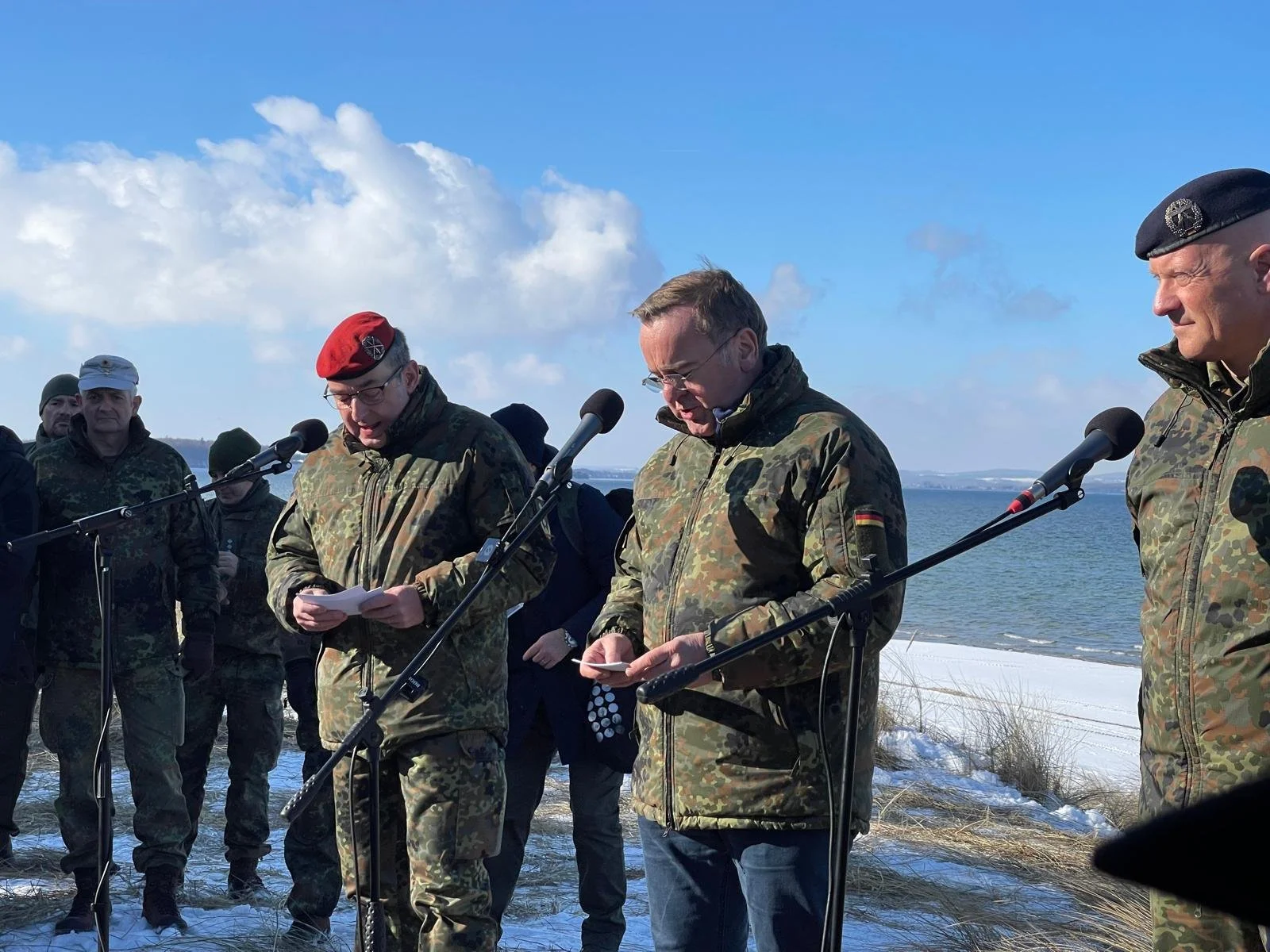
Germany’s defence minister Boris Pistorius addresses the media after a demonstration designed to showcase NATO’s speed, coordination and deterrence.
Yet the reliability and determination of those allies has very much been in question since the full-scale invasion of Ukraine, and since the re-election of Donald Trump. Rapid deployment is just part of what NATO is trying to do though. The reason we were there was a renewed prioritisation of deterrence. The displays that we and other media had been invited to were supposed to showcase publicly what the alliance is capable of - and likely with a few key people in mind. Colonel Mathias Boehnke from JFC Brunssum - responsible for the exercise - told me that the conditions had been a challenge, especially for forces used to warmer climes. Yet NATO forces, he claimed, had done “very well.” “We can do better also in terms of drones. Drones is now the topic overall. Everybody is interested, and it is, as you said, in the conflict in Ukraine, in the war in Ukraine, it is a big topic, and yes, we learned a lot in the last years.”
NATO believes it is moving forwards, and there were clear positives to take away from its exercises. Steadfast Dart 2026 was a reminder that NATO countries are willing and able to coordinate large, complicated and impressive defence equipment across different terrain. The speed of such a deployment is a difficult thing to judge, given we had no indication how long the exercises had been planned and strategised.
Perhaps most significant however is JATEC - the Joint Analysis, Training, and Education Centre. This, according to some inside NATO, may be the alliance’s future.
JATEC is a programme barely a year old, described as the first joint civilian-military organisation within NATO dedicated to the systematic analysis of the Russia-Ukraine war. NATO’s website calls it the first NATO-Ukraine joint civil-military organisation; its aim is to facilitate innovation.
To that end, we were given an hour inside a tent with some of those involved. Small, young start-ups with funding from defence giants and involvement in the NATO ecosystem - were showcasing their tech designed around the battlefield of the future.
Much of it has been tested in Ukraine, we were told. Alta Ares’ Shahed hunter “Blackbird” was one - tested in Ukraine, said to be able to catch one of the scourges of the skies there and intercept effectively, and affordable. Others included medical evacuation land drones, AI solutions for battlefield analysis and more. The vast majority of those inside the tent exhibiting were under 50.
There are those who are forward looking within the alliance. The question I couldn’t find an answer to was the extent to which they were being listened to.
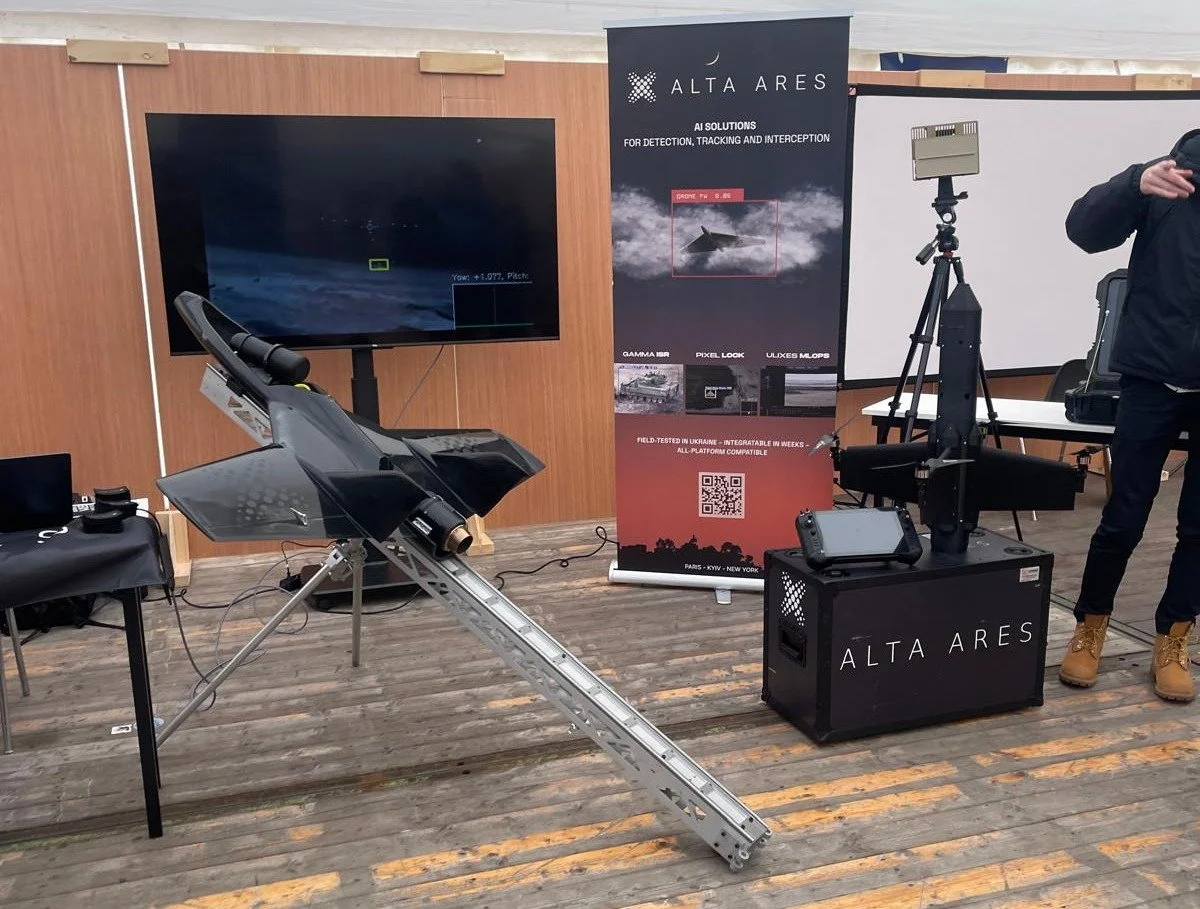
Inside the JATEC technology tent, Alta Ares presented its Blackbird system - one of several attempts to turn lessons from Ukraine into battlefield innovation for NATO.
A shadow had hung over the exercises before we arrived. A team of around 10 Ukrainians had managed to essentially shut down a NATO war game in Estonia months earlier by “destroying” most of the units and troops involved. A similar thing happened again in Sweden in April. NATO may be able to rapidly coordinate and deploy some of its forces. It may believe it has the political will to act. It may even be able to deal with the withdrawal of critical US forces from Europe, and deter Russia or anyone else from attacking it in the future. But on the evidence so far, there are few signs that it would be able to fight the war in Ukraine as it currently stands. There are many reasons why those discussions should be paramount this week in Sweden and beyond.
Often the case with NATO is what’s said at the end of answers, not the beginning. Colonel Boehnke ended our chat with the admission that lingered in the air on that German beach, and will hang among foreign ministers and their delegations in Helsingborg:
“Can we do more? Yes, we have to do more.”
